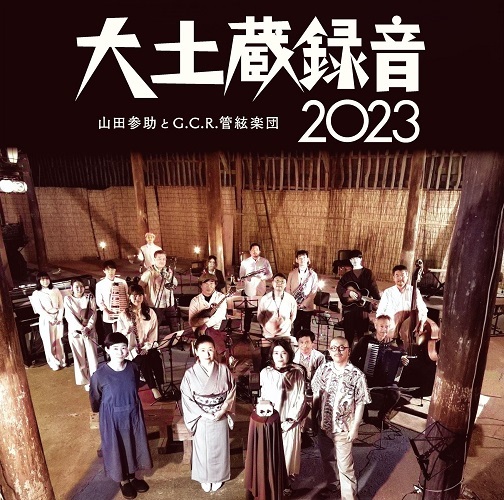
Tetsuhiro Daiku recorded some of the most groundbreaking and pioneering Okinawan music of the 90s when he combined Okinawan music with chindon. In 2006 he's reunited with some of the same musicians (the Aurasian Brass Band) but for the first time possibly Japan's leading chindon group from Osaka, the mighty Chindon Tsushinsha. The results don't disappoint. This is a big project, some 23 musicians playing chindon, trumpet, clarinets, banjo, saxophones, accordion, tuba, ukulele, pianica, electric guitar, Hammond organ and more are combined with Daiku's sanshin and distinctive voice. It's not overproduced however, instead each track sounds different but the album hangs together perfectly. The 16 tracks are mostly Japanese songs dating back to between 1901 and 1935, mostly from the 1920s, the hit songs of the day. There are some children's songs too featuring a charming small children's choir. A monumental album.
The first groundbreaking collaboration between Daiku and sax player Kazutoki Umezu. Okinawan traditional tunes and sanshin with cello, percussion, bass, guitar, clarinet, sax, piano and pianica. Originally released in 1993 still sounds as good as ever. Price: £18.99
Superb double album featuring Daiku's now regular Japanese band members and a few new additions. Mandolin, accordion, tuba, saxophone, ukulele, piano, drums, percussion and a host of other instruments accompany Daiku's sanshin and vocals, with some help on vocals by wife, Naiko. Songs range from Japanese standards, such as 'Japanese Rumba', to Okinawan traditional favourites such as Asadoya yunta' and some originals. The theme of the album is searching for a 'utopia' of non-categorized, just good music. In this they have definitely succeeded. Constantly surprising, challenging and entertaining.
Geoffrey Keezer is a first class jazz pianist, having started off playing with Art Blakey then going to record with a host of top musicians from Diana Krall to Chick Corea. He is also a great collaborative musician having played with Hawaii's Keola Beamer. Like many before him, including fellow pianists George Winston and Michael Nyman, he seems to have caught the Okinawa bug and has recorded an album with Yaeyama's Yasukatsu Oshima. Oshima is a fantastic sanshin player, has Okinawan music running through his vains and is one of the best interpreters of traditional songs. Excellent album of 10 songs, with Keezer an innovative yet wholy respectful collaborator. Recorded in New York the album also features several of Keezer's regular jazz band, on saxes, clarinet, electric guitar, trumpet and drums. A varied album with some hauntingly beautiful moments, and some more upbeat joyful times. Recommended. 1. Ryusei ( Oshima original) 2. Tsuki nu Kaisha (Yaeyama traditional) 3. Kuinupana (Yaeyama traditional) 4. Sukikanna (Okinawa traditional) 5. Tinsagu nu Hana (Okinawa traditional) 6. Menuhama (Okinawa traditional) 7. Agarikata Bushi (Oshima original) 8. Sagechijyuya (Okinawa traditional) 9. Ufarakuitsui (Yaeyama traditional) 10. Uyamaari (Yaeyama traditional).
Price: £18.99
Excellent new album from the wonderful singer and sanshin player from Ishigaki island, Yaeyama. Oshima has a brittle, expressive voice, steeped in tradition yet distinctively his own. On this album of 13 tracks, Oshima plays both traditional standards from Yaeyama and Miyako island, and a smattering of his own songs. The impressive guest list includes Kanako Hatoma (voice, hayashi (backing vocals) sanshin, UA (hayashi) Ayano Kinjo of Kiroro (piano), Jiang Juan Hua (erhu) and Dermot Byrne from Altan (accordion).
Ohshima's fifth album and one of his best. His dramatic voice and sanshin are accompanied by mainly violin, guitar and percussion. However, there is little compromise to Western music, despite the songs being mostly Ohshima originals, they still sound deeply rooted in hundreds of years of tradition. Finally receiving some deserved recognition at home, and has successfully toured in the UK. Still in his early thirties, arguably the new standard bearer of Okinawan traditional music. Comes with excellent English liner notes and lyric translations. Price: £18.99
Wonderful performances of traditional material by male singer and sanshin player. Has been well known in Okinawa for years, but recently his fame has spread to the rest of Japan through his starring role in the hit Okinawan film 'Hotel Hibiscus'. Has taught a few Japanese musicians the sanshin, such as Donto and Hashiken, and is regarded as one of the great craftsmen for making the Okinawan banjo, the sanshin.
The father of Rinken Teruya sings charming versions of children's songs and his own compositions. One of the earliest mixes of Okinawan and western music, with electric guitar, drums, bass and sanshin, and vocalist including Four Sisters.The best Rinsuke Teruya album available. Rinsuke died in 2005, but his music lives on, on this glorious album. Price: £18.99
Wataru Takada was a 'folk' singer with a special interest in Okinawa who died in 2005. This is a two track single from Wataru Takada together with female Okinawan singer Keiko Kinjo. Similar to some of Tetsuhiro Daiku's material, with Okinawan songs accompanied by violin, tuba, clarinet, accordion and shuffling rhythms.
Father of Rinken Teruya, Rinksuke's "Watabu", or "Mr Fat Belly" show has been a institution in Okinawa for years.Music and some talk, but it all adds to the fun atmosphere. Price: £18.99
It's summer in Okinawa, that means it's time for the Eisa festival, held in July Taiko drums are played by brightly clad dancers in a noisy and colorful event. Eisa takes place on the streets and in fields and each town in Okinawa has its own variation of Eisa tunes. Eisa is equivalent of Japanese obon when dead anscestors are said to return. This superb 2 CD set features three performers, the omnipresent Toru Yonaha joined by Hirokazu Matsuda and Kazutoshi Matsuda, the songs focussing on two areas of Okinawa on each CD. Musically, the banging of taiko drums are accompanied by stern male unison vocals, sanshin, the occassional wistful flute and plenty of chants of 'heeya sa sa, haiyeea!'
Born in 1976 Toru Yonaha is one of Okinawa's most in demand musicians. On this album of Okinawan roots and pop he is joined by various collaborators such as Japanese pop star Masamune Kusano of Spitz, Kiyosaku from Okinawan indie rock group Mongol 800, plus female singer Misako Koja, Shakari and Yasukatsu Oshima.
No celebration in Okinawa would be complete without a performance of dance tunes called kachashi. Kachashi is an integral part of Okinawan people's lives. The most distinctive feature of the music is lightning fast sanshin (banjo) playing, accompanied by Okinawan drums, castanets and whistling. The lyrics can be improvised, but more usually are written down. The songs usually consist of short musical phrases which are continually repeated building up to a frenzied climax. Dancers fling their upraised arms and twist their hands, in a distinctive Okinawan way, with echoes of southeast Asian dances from Bali orThailand.Kachashi originates in the mo-ashibi revelries of pre-war Okinawa village and beach parties.This album features the most well known kachashi songs.Toru Yonaha is a young musician, and a wonderful interpreter of traditional minyo. The concept, production and choice of supporting musicians are all his.The songs are arranged in an orthodox style, yet sound fresh and dynamic in the hands of the youthful Yonaha and his supporting cast, which includes Mika Uchizato, who sang with US/UK duo Ryukyu Underground.The eleven tracks on this album are some of the most famous kachashi tunes, ending with the classic 'Toshin Doi' featuring eight vocalists. 11 tracks. 1. Honen Ondo 2. Kadeku 3. Chatanmae - Ikei Hanari Bushi 4. Chatan Maikata - Acchamee Guwa 5. Takohyama
6. Harikuyamaku 7. Umi nu Chimboura 8. Okinawa Samba 9. Maeda Bushi - Safuen Bushi - Inesuri Bushi
10. Asobi Amakawa 11. Toshin Doi
The young Okinawan singer and sanshin player continues to make a name for himself on his second album, with a more distinctive brand of shimauta. Much in demand as a producer, session and support player, recently producing Okinawan singer Chihiro Kamiya and performing live with Okinawan star Rimi Natsukawa, including the national new year TV competetion 'kohaku'. This album includes some of Yonaha's own songs as well some traditional classics. He's a good singer, plays sanshin well and is backed up by a competent band. While good, the electric guitar and western drum kit on most tracks tend to drown out the music's undoubted qualities. Price: £18.99
First album by young singer who was first heard on Misako Koja's (ex Nenes) album. Sings, plays sanshin, ryukin (koto, or harp), fue (flute) taiko, eisa (drums) and guitar on album of traditional and contemporary material.
After the death of Rinsho Kadekaru, perhaps Seijin Noborikawa stands as the island's most loved and respected elder muscian. But Noborikawa (or "Seigwa" as he is often referred to) equally stands alone. He doesn't fit into the 'traditional' musician category easily. He doesn't usually dress in kimono, doesn't only sing traditional repertroire but composes his own, anti-war and other protest songs, developed his own six string sanshin, the 'rokushin', and is known as the Okinawan 'Jimi Hendrix' for his fast sanshin playing. Born in Hyogo Prefecture in Japan in 1930, he moved back to Okinawa as a child. A sanshin player from childhood he performed as a backing musician for the Matsuda Gekidan Theatre Group, where he perfected the traditional style and first met Rinsho Kadekaru, an association that would last a lifetime. Noborikawa later worked on an American base where he heard and digested the American hit songs of the day, an influence that crept into his own music. Nevertheless, he was one of the founding members and later president of the Ryukyu Min'yo Kyokai, a traditional music society, and taught the sanshin to a 12 year old Sadao China. Perhaps overshadowed by Kadekaru and other traditional singers, he released relatively few albums. A couple of cassettes for Marafuku in the 1960s, an album for JVC in 1975, and then a comeback album in 1998, 'Howling Wolf". It was only after his starring role in the 1999 film "Nabbie no Koi" (Nabbie's Love) that his fame spread to the rest of Japan. "Spiritual Unity" was produced by Takashi Nakagawa of Soul Flower Union, who along with his band mates plays on some of the songs. It features both well known traditional songs, and new compositions penned by Noborikawa, highlighting his unique lyrics and songs. Price: £18.99
New album by the man behind Surf Champlers and Sarabandge and Okinawan Cafe Music. Solo sanshin playing of contemporary classics of Okinawan music, in fairly easy listening style. Songs includes Hana (Shokichi Kina), Nada Sousou (Rimi Natsukawa), Shimanchu nu Takara (Begin), Shimauta (The Boom), Warabigami (Misako Koja), and classics such as Asadoya Yunta, Tinsagu nu Hana and Akata Sun Dunchi. Great as background music and to hear some of Okinawa's best known melodies on it's most recognized instrument.
Stunning double CD is contender for the best Okinawan album of 2000. Disc 1, Singapore-Gwa, is a glorious blend of Okinawan sanshin with guitar, drums, bass, organ, sax, tuba and more, with warm vocals, singing songs of emigrating to Singapore by boat, and other emigration songs. Disc 2, Tropical Hot Dog Night,is a straight, traditional, sanshin and vocal set. Price: £21.99
Shimoji is from one of the most beauiful outlying islands of Okinawa, Miyako. On this album he sings in the local Miyako dialect, music with elements of rock, blues and jazz, together with various guest musicians including Kantaro Uchida (ex- Yukadan) on guitar, Nobu Saito on percussion and Masaru Shimabukuro from Begin also on guitar.
From the tiny Okinawan island of Minami Ubuagari Jima, Hama-chan sings a kind of mixture of Okinawan minyo with Japanese pop. Price: £18.99
Iriomote is the westernmost of the Okinawan islands, but is generally not as known for its music as Ishigaki, or even Miyako. Suguru Ikeda is a young singer and sanshin player with a fairly deep and raspy voice. He is accompanied by piano player Chigusa Ishikawa on renditions of mainly Iriomote island songs. While the piano is fine on a couple of tunes, having it throughout takes the album too far into new age territory, and makes this a one dimensional album. Suffering from lack of variety, nevertheless, the album has some beautiful moments, mostly because of some great songs and singing.
New album of Eisa tunes by the gruff voiced Hidekatsu. Enjoyable album, good selection of tunes by popular local musician mixing shima uta and rock with more emphasis on the latter. Price: £18.99
Plucked from Rinken Teruya's record company audition, 13 year old boy singer and sanshin player.
At one time Yaeyama born Yukito Ara was branded the leader of the new generation of Okinawan singers, with his group Parsha Club. On his new solo album he's back to playing the traditional minyo from his native Yaeyama islands. An effective singer and great sanshin player on a well recorded album. Looks set to become a mainstay of the Okinawan music scene. Price: £18.99
Vocalist with the band 'Cobra Twisters' sings Okinawan songs and his own original tunes inspired by his native Yoron Island. Helping him to make a successful first solo album are Takashi Hirayasu and the excellent Black Bottom Brass Band.
Okinawan bluesy folk singer/songwriter. Some songs incorporate Okinawan traditional elements, with probably the album's most successful moment the guest vocals of Misako Ohshiro, and violin of Rinji Kadekaru. Another side of Okinawa. Price: £18.99